
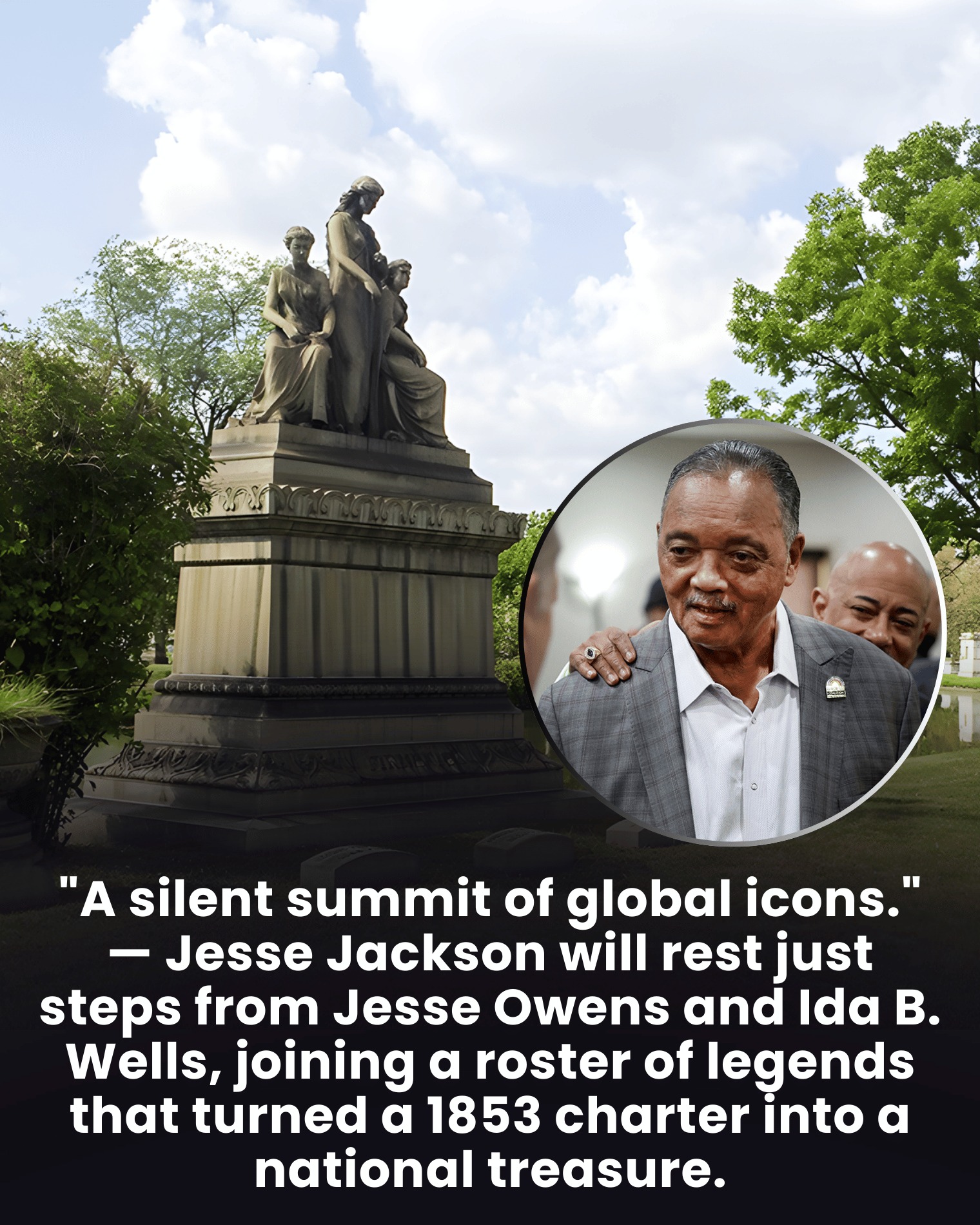
The quiet pathways of Oak Woods Cemetery in Chicago have long served as more than just resting places for the departed. Established under a charter granted in 1853, the cemetery has gradually transformed into a remarkable archive of American history. Walking through its tree-lined grounds feels less like visiting a burial site and more like stepping through a living chronicle of individuals whose lives shaped science, civil rights, culture, and politics. Now, with the passing of civil rights leader Jesse Jackson, the cemetery adds another towering figure to a legacy that already includes some of the most influential names of the last two centuries.
Jackson's burial at Oak Woods places him among extraordinary company. Only steps away lies the memorial of Jesse Owens, the Olympic legend whose triumphs at the 1936 Berlin Games shattered Nazi propaganda and redefined the global perception of Black athletes. Owens' monument, marked with the iconic Olympic rings, stands near one of the cemetery's serene lakes—a quiet reminder of the moment when athletic excellence became a symbol of defiance against racial ideology. Nearby also rests Ida B. Wells, the fearless investigative journalist and anti-lynching activist whose writings exposed brutal injustices and galvanized early civil rights movements.
To understand the significance of Jackson joining this group, one must appreciate the remarkable history contained within Oak Woods itself. The cemetery welcomed its first burial in 1865, the same year the American Civil War ended. Over the decades, its grounds expanded into a sprawling memorial landscape, now encompassing more than 180 acres filled with monuments, sculptures, and carefully preserved headstones. In many ways, the cemetery mirrors the evolution of the nation, holding the stories of pioneers who helped shape modern America.
Among those honored there is physicist Enrico Fermi, one of the key figures behind the development of nuclear energy and the world's first nuclear reactor, which was built at the University of Chicago during World War II. His groundbreaking work forever changed the course of scientific discovery. Also buried within Oak Woods is John H. Johnson, the publishing visionary who founded Ebony and Jet magazines. Through his publications, Johnson gave a powerful voice to African American stories and culture during an era when mainstream media often ignored them.
This remarkable collection of individuals has turned Oak Woods into something akin to a "silent summit" of global icons. Each monument represents a life that pushed boundaries, challenged injustice, or expanded human knowledge. Together, they form an enduring assembly of people who, in different ways, moved the world forward.
For Jesse Jackson, the location carries deep symbolic weight. Throughout his life, Jackson stood at the forefront of the civil rights movement, working alongside leaders such as Martin Luther King Jr. and later continuing the fight for racial equality, economic justice, and political representation. His campaigns for the U.S. presidency in the 1980s helped broaden national conversations about diversity and inclusion, inspiring new generations of political engagement.
Being laid to rest at Oak Woods therefore represents more than a final resting place. It places Jackson within a historic lineage of individuals who challenged the status quo and reshaped society through courage and determination. As visitors walk through the cemetery's quiet paths in the years to come, they will encounter his name alongside Owens, Wells, Fermi, and Johnson—figures who each left an indelible mark on history.
In that sense, Jackson's burial is not merely an ending. It is an induction into an enduring legacy, a gathering of voices across time whose collective achievements continue to inspire those who follow.