
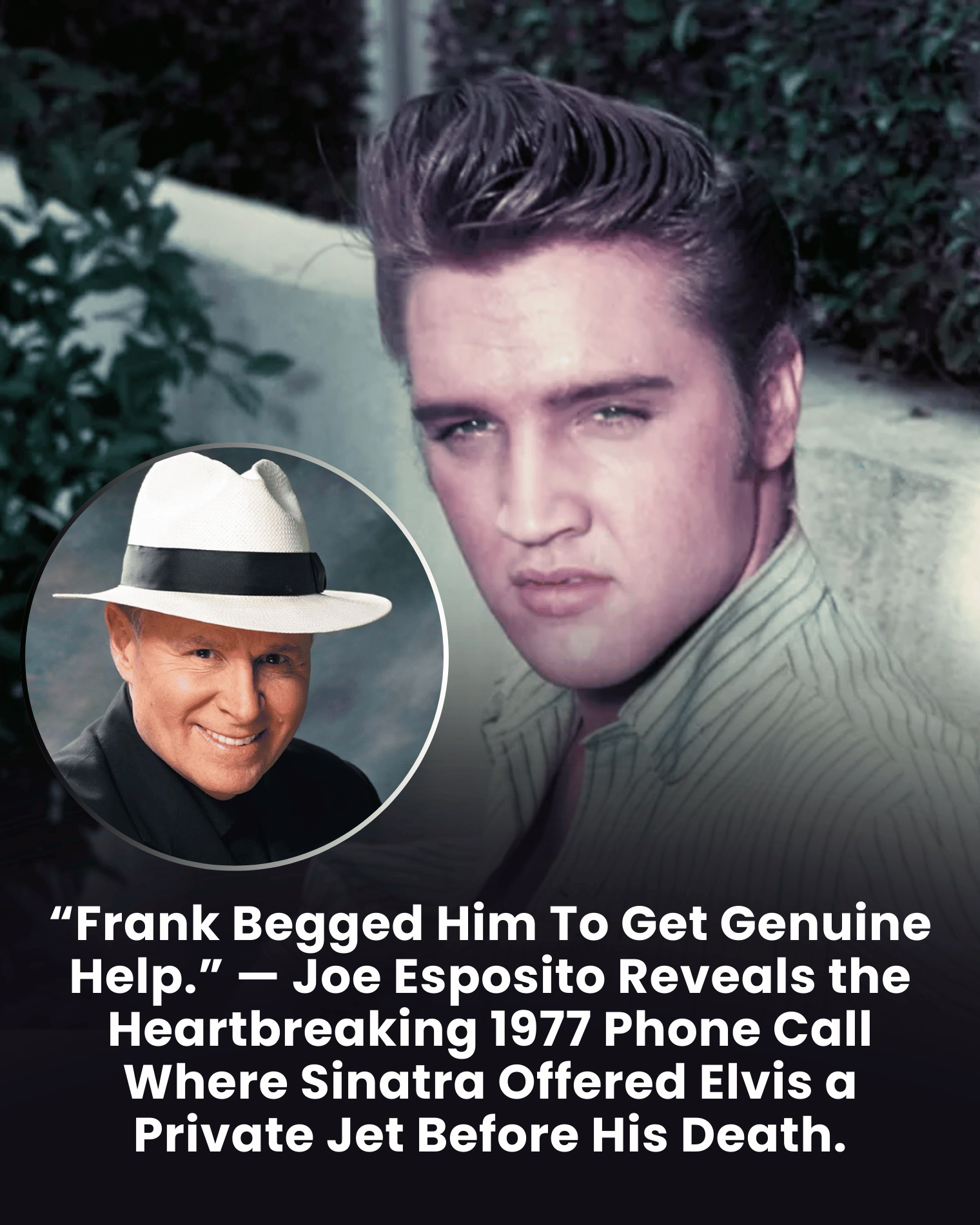
In the summer of 1977, those closest to Elvis Presley could see that the legendary performer was struggling. Years of relentless touring, personal pressures, and declining health had begun to take a visible toll on the man who had once electrified the world with his voice and charisma. Among the people witnessing that painful decline firsthand was his longtime road manager and trusted confidant, Joe Esposito.
According to Esposito, the atmosphere around Elvis during those final months was heavy with concern. Friends and members of his inner circle understood that the King of Rock and Roll was not the same unstoppable force who had once dominated stages across the globe. Behind the scenes, the people closest to him quietly worried about his health and emotional well-being.
One afternoon that summer, Esposito recalled an unexpected phone call that left a lasting impression on him. The voice on the other end belonged to none other than Frank Sinatra—a towering figure in the entertainment world who, despite occasional public rivalry with Elvis in earlier years, held a deep respect for him.
Esposito remembered the tone of Sinatra's voice immediately. It was serious, direct, and filled with urgency. Sinatra asked to speak with Elvis personally. The request carried weight not only because of Sinatra's stature but because he appeared determined to bypass the usual management channels, including Elvis's longtime manager, Colonel Tom Parker. Sinatra, Esposito said, wanted to speak to Elvis directly and privately.
When Elvis came to the phone, Sinatra reportedly spoke to him with remarkable honesty. According to Esposito's recollection, Sinatra expressed genuine concern about Elvis's health and the exhausting pace of his life. Rather than offering vague encouragement, Sinatra presented a concrete plan. He told Elvis that he was willing to send his own private jet to Memphis, quietly and discreetly, so Elvis could travel to a private facility where he could rest, recover, and seek medical help away from the relentless attention of the press.
The offer was extraordinary. Sinatra was one of the most powerful figures in show business, and the idea of quietly arranging such a retreat showed how deeply he cared about Elvis's well-being. For Sinatra, it wasn't about publicity or industry politics—it was about trying to help a fellow entertainer who was clearly struggling.
But according to Esposito, Elvis responded in a way that was familiar to those who knew him best. He remained polite and appreciative but ultimately brushed the offer aside. Elvis had often reacted this way when confronted about his health or lifestyle. Rather than engage deeply with the concern, he would gently deflect it and move forward as though everything was under control.
Esposito later reflected on that moment with sadness. As he watched Elvis hang up the receiver, he sensed that something important had just slipped away. Sinatra's offer had been more than a friendly gesture—it may have represented a genuine opportunity for Elvis to step away from the pressures surrounding him and focus on healing.
Just weeks later, in August 1977, Elvis Presley passed away at the age of 42 at Graceland. Looking back, Esposito often remembered that phone call as one of the final moments when someone outside Elvis's immediate circle tried to intervene.
For him, it was a painful reminder that even the biggest stars can struggle in silence—and that sometimes the help offered by friends, even powerful ones like Frank Sinatra, arrives too late to change the course of history.